
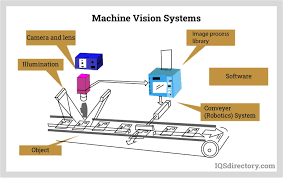
Description
Computer Vision Systems
1. Image Recognition
Identifies and classifies objects, people, or scenes within digital images.
Description: Uses deep learning algorithms to automatically detect patterns and categorize images (e.g., identifying faces, products, or vehicles).
2. Object Detection & Tracking
Locates and monitors multiple objects within images or video frames in real time.
Description: Commonly used for surveillance, traffic management, industrial automation, and retail analytics.
3. Facial Recognition
Analyzes facial features to identify or verify individuals.
Description: Used for biometric security, attendance systems, personalized customer experiences, and access control.
4. Optical Character Recognition (OCR)
Converts printed or handwritten text into digital, editable data.
Description: Automates data entry and document processing from scanned papers, invoices, IDs, and receipts.
5. Image Segmentation
Divides an image into meaningful regions or parts for detailed analysis.
Description: Useful in medical imaging, defect detection, and autonomous driving for identifying boundaries of objects.
6. Video Analytics
Processes and analyzes live or recorded video streams for insights and alerts.
Description: Enables applications like motion detection, behavior analysis, safety monitoring, and event recognition.
7. Gesture & Action Recognition
Interprets human gestures or actions through visual inputs.
Description: Enables touchless control interfaces, gaming interactions, and smart surveillance systems.
8. Quality Inspection & Defect Detection
Automatically inspects products for flaws or inconsistencies during manufacturing.
Description: Improves accuracy, reduces production errors, and enhances quality control through AI-based visual inspection.
9. 3D Vision & Depth Sensing
Analyzes spatial dimensions and depth information from visual data.
Description: Supports robotics, autonomous navigation, and AR/VR environments with spatial awareness.
10. Medical Imaging Analysis
Assists in identifying diseases and abnormalities from X-rays, MRIs, and CT scans.
Description: Enhances diagnostic accuracy and speeds up healthcare workflows using AI-driven image analysis.
11. Scene Understanding
Interprets the overall context and layout of an image or video scene.
Description: Enables autonomous systems to understand surroundings for tasks like navigation or object placement.
12. Anomaly Detection
Identifies unusual patterns or irregularities in images and video streams.
Description: Applied in security, industrial maintenance, and fraud detection to flag abnormal events automatically.
13. Edge AI Processing
Runs computer vision algorithms directly on edge devices (e.g., cameras, drones).
Description: Reduces latency, increases privacy, and improves performance by processing data locally instead of in the cloud.
14. Integration with IoT Systems
Connects vision systems with Internet of Things (IoT) devices for smart automation.
Description: Enables intelligent decision-making in connected environments such as smart factories or cities.
15. Data Annotation & Model Training
Provides labeled datasets for training and refining vision models.
Description: Ensures high accuracy in object detection, classification, and segmentation tasks by improving model understanding.
16. Augmented Reality (AR) Integration
Combines real-world visuals with digital overlays.
Description: Powers interactive applications in retail, education, and design by merging AI vision with AR interfaces.
Reviews
There are no reviews yet.